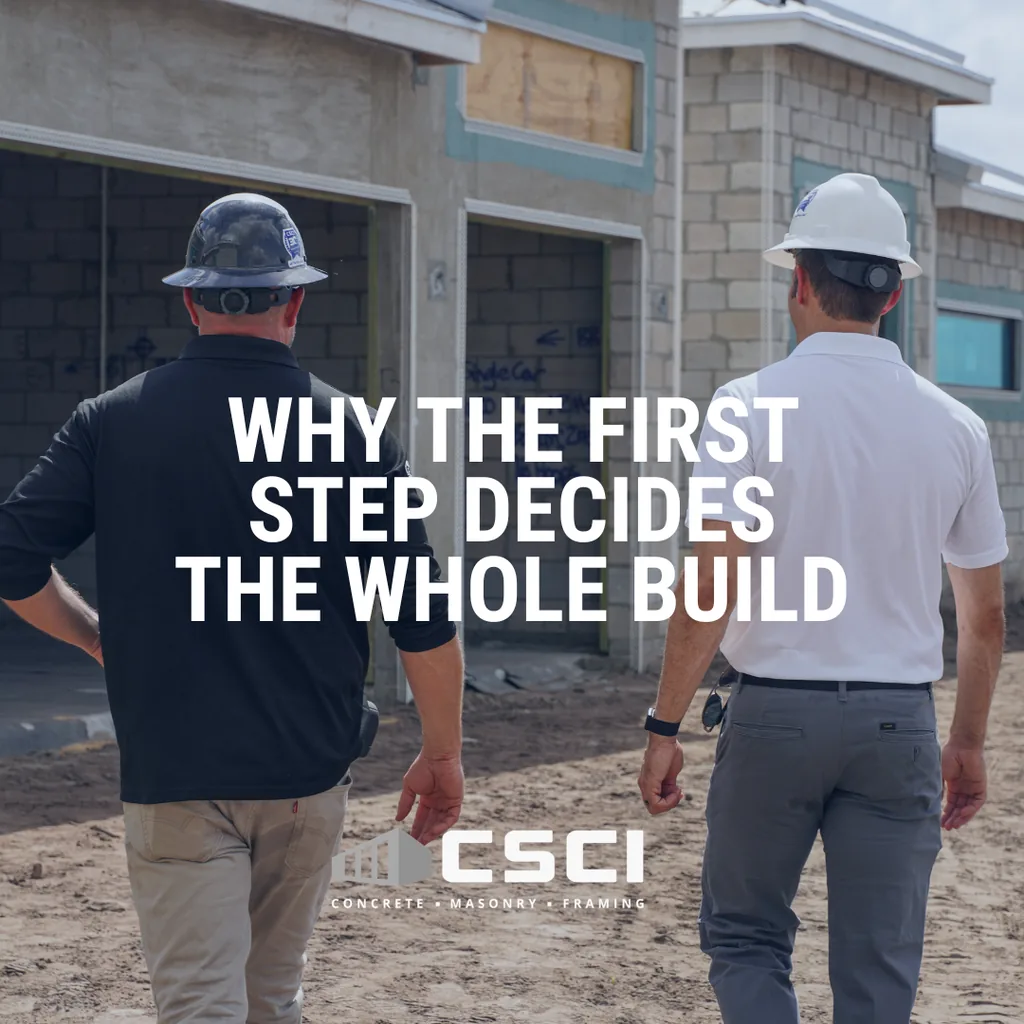
Every building starts the same way. Before the paint, the cabinets, or the front door, there’s the shell. It’s the concrete and block structure that holds everything up, the bones of the house. It’s the part nobody notices once the home is finished, and it’s also the part that decides how the rest of the project goes.
Every other crew that shows up later, the interior framers, the plumbers, the finish carpenters, builds on top of what the shell crew leaves behind. If that structure is straight and true, everyone who follows starts from a clean, level base. If it’s a little off, everyone who follows has to work around the mistake. And small mistakes at the start don’t stay small.
A Little Off at the Start Becomes a Lot Off Later
Picture a wall that ends up just a half-inch out of line. On its own, half an inch sounds like nothing. But the next crew has to adjust to it, and the crew after that adjusts to them, and the error grows as it moves down the line. By the time someone’s hanging a door or setting a countertop, that tiny miss at the beginning has turned into a door that won’t close right and a counter that won’t sit flat. Nobody can quite trace it back, but everybody pays for it.
That’s why the shell is the least forgiving part of a build. You can’t fix it at the end. Whatever you get wrong here, you carry the whole way through.
Why the Cheapest Bid Often Costs the Most
When builders hire out the shell, it’s tempting to go with the lowest price. It feels like a smart savings. But the industry numbers tell a different story. Most construction projects end up over budget, and a big reason is the cost of fixing work that wasn’t done right the first time. That kind of do-over work, called rework, can eat up a real chunk of a project’s total cost and stretch its timeline by weeks.
A low bid that skips steps or glosses over the details doesn’t actually save money. It just moves the cost down the road, where it shows up later as a change order, a delay, or a repair. The savings on paper turn into a bigger bill in the field.
How We Do It Differently
At CSCI, our approach isn’t complicated, and that’s the point. We do the ordinary things right, every time, whether anyone’s watching or not.
We quote the real cost up front, so there are no surprise charges halfway through. We double-check the measurements and details before the concrete is poured, because once it’s set, fixing it is expensive and slow. And we build the structure straight and square from the very first block, because we know what a small shortcut here costs everyone later.
Just as important, the same crew stays on your project from start to finish. When people rotate on and off a job, quality slips in the handoff, because the new crew is learning as they go. Our crews stay together, so the team that starts your build is the team that finishes it. Nobody’s relearning your project halfway through.
What It Means for You
All of that shows up in ways you can actually feel. Fewer surprise costs, because the problems that cause them get caught before the concrete goes down. A schedule that holds, because the crews that come after us start on solid, accurate work instead of fixing ours. And a price you can count on, because the number we give you on day one is the number that stands.
Getting the shell right isn’t the flashy part of building a home. But it’s the part everything else depends on. Do it well, and the whole project goes smoother. That’s the CSCI standard, and it’s the reason our partners keep bringing us back for the next one.